
THE HONEST GAME
I did not learn this from a textbook. I learned it from a game that was not trying to persuade me.
In civilization and city-building simulations, the rules are blunt. You place a town. You assign workers. You watch numbers stabilize or collapse. The game does not pretend people are free. It does not romanticize “choice.” It does not moralize outcomes.
It simply shows you what a system requires.
At first, it feels harmless. You drop a town center. You build a log mill. You assign a worker to it. You build a farm. You assign someone there too. You quarry stone. You mine metal. You build housing. You keep the lights on, so to speak, in a world where light is measured in wood and food and labor.
Food. Wood. Stone. Metal.
Those are not political ideas. They are the backbone. They are the material inputs that keep the civilization alive and moving forward. And the first thing the game teaches you is that these inputs are non-negotiable.
Someone must cut the trees.
Someone must grow the food.
Someone must haul what is extracted into what is useful.
You cannot not have somebody at the log mill.
The log mill does not “solve itself.” The farm does not become philosophical. The quarry does not stop needing hands because you have a vision for your society. In these games, the survival layer is always there, always hungry, always demanding.
Then the city grows, and the math tightens.
Every new person requires food.
Food requires workers.
Workers require housing.
Housing requires materials.
Materials require workers.
And each addition to society increases the demand for the very labor that sustains it. If you add one person, you do not merely add one person. You add a mouth, a bed, a tool, a heat source, an infrastructure burden. Growth creates its own demand. It pulls more people into the base layer just to keep the base layer from cracking.
So you start to notice something that is not framed as ideology in the game, but as necessity:
Most of your society will be locked into high-labor, high-output roles that are never meant to progress.
Not because the game is cruel. Because the system is built on throughput.
There is always a shortage somewhere. Always a chain that can break. Always an input that runs behind. And the quickest way to ruin your civilization is to let too many people leave the survival layer at once.
You can build universities and temples and courts and monuments. You can create upper tiers—specialists, administrators, elites—people whose work is not directly tied to extracting food from soil or wood from trees. But the game makes something clear: those layers only exist because the base layer holds.
If the base layer wavers, everything wavers.
And this is where the game becomes unsettling, because it teaches you a truth you cannot easily unlearn.
Class is not an accident.
Class is a stabilizing mechanism.
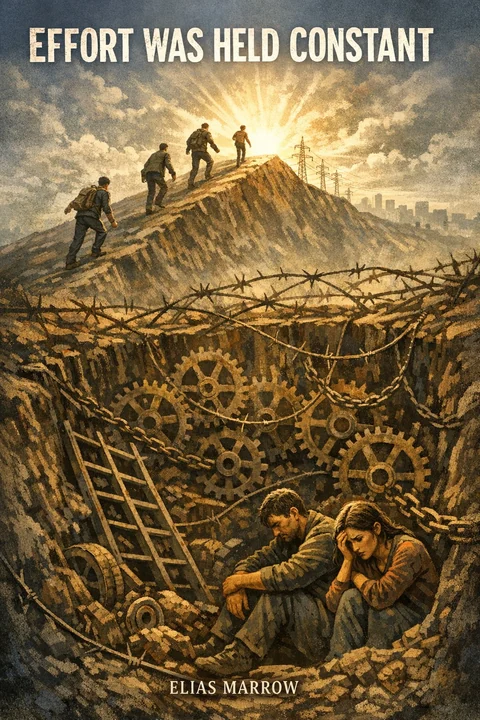
You may tell yourself you are building upward. But what you are actually doing is holding most people in place so a smaller number can move.
If everyone advances, the system breaks.
This is not rhetoric. It is not a “take.” It is what the mechanics demand.
You can attempt to promote everyone. You can attempt to educate everyone into higher roles. You can attempt to make advancement universal. And the game will let you try—right up until the farms underproduce, the log stocks empty, the production queues stall, and the civilization begins to starve on the edge of its own ambition.
So you make a choice.
You keep people where they are useful.
You keep the backbone staffed.
You keep certain areas poor—not necessarily in currency, but in status and mobility—because you need that labor to be stable, reliable, and close to the work. You need workers who do not leave the mills. You need hands that do not wander away from the fields.
Not because you hate them.
Because if they leave, the city collapses.
The game is honest about something reality rarely admits: it is not enough for a society to want equality. A society built on labor-intensive survival inputs will always be tempted to lock most people into those inputs.
And then, if you play long enough, the most interesting point arrives: the end-game.
Automation improves. Production chains optimize. Farming becomes autonomous. Extraction becomes efficient. The civilization reaches a point where it no longer depends on population growth to sustain itself.
The machine feeds the machine.
At that point, the role of the citizen changes.
They stop being necessary.
They become consumption.
They become overhead.
They become, in the cold language of any optimization problem, a cost.
Some games make this logic explicit. Once you are autonomous—once the land is stripped, the resource chains are stabilized, the production is self-sustaining—you can convert your population into soldiers. You can turn civilians into something that still has utility: force, security, expansion.
And then, when you cannot convert them anymore, the simplest move becomes the most brutal:
You eliminate the civilians.
Because all they will do is take resources you do not need them for anymore.
The game does not call you evil. It does not play villain music. It does not moralize the decision. It offers it as a rational late-stage action: reduce overhead, preserve stability, maintain control.
It is horrifying because it is not presented as horror. It is presented as efficiency.
And when you see that, you start seeing the shape of the same logic in reality.
In real life we talk about “choice” as if it exists in equal measure for everyone. We talk about “personal responsibility” as if option sets are evenly distributed. We talk about advancement as if the system is designed for universal upward mobility.
But most people behave like the citizens in the simulation because most people are constrained like them.
They work what is close.
They do what is available.
They take the job that will accept them.
They buy what they can reach and afford.
They stay in the tier that the environment allows them to stay in.
The game is honest about this. Reality hides it behind stories.
The game shows you that the backbone of a civilization is resources and the labor that turns resources into life. Reality often pretends the backbone is virtue.
The game shows you that for every person you add, the system demands more extraction and more maintenance. Reality calls this “growth” and treats it like a moral good.
The game shows you that class stratification is not merely a failure of compassion. It is a functional arrangement that keeps the machine stable. Reality treats stratification as an unfortunate side effect rather than a requirement.
And the end-game lesson—the one that stays with you—shows you what happens when people cease to be economically necessary.
In the game, the solution is clean. The system does not require legitimacy. It requires stability.
In reality, legitimacy matters. We cannot openly say, “Some people are surplus.” We cannot openly say, “The system does not need you.” We cannot openly say, “Containment is cheaper than meaningful change.”
So we disguise the same logic in softer language. We rename it. We moralize it. We make it a personal failure instead of a structural consequence. We call it laziness. We call it crime. We call it decline. We call it anything that keeps the underlying math out of view.
That is why civilization simulations can be so revealing. They strip away the lies we need to tell ourselves to keep living in the system without seeing it.
They make the machinery visible.
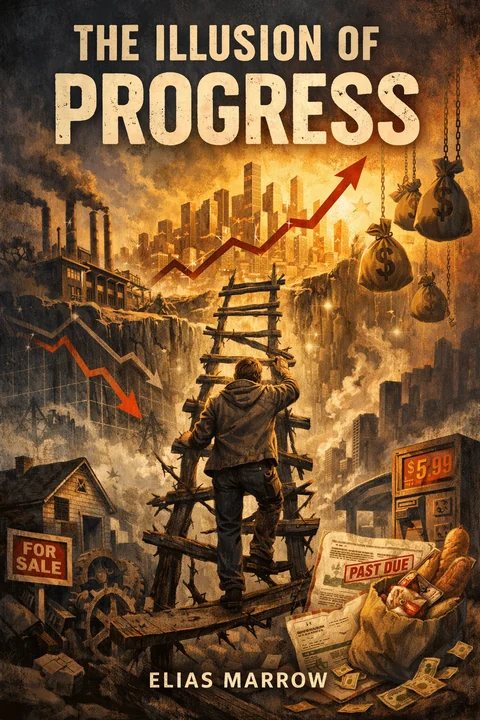
They show you that “good leadership” often means making tradeoffs that would be condemned if spoken plainly. They show you that stability frequently depends on immobility. They show you that advancement for all is incompatible with systems designed around extraction throughput and permanent maintenance burdens.
And they show you—without meaning to—that the question is not whether a society contains inequality.
The question is whether a society is designed so inequality is required for it to function.
If the backbone of a civilization is labor-intensive survival work, and if growth continually demands more of that work, then the lowest class is not a temporary condition. It is a structural position.
A slot that must be filled.
A floor that cannot be removed without collapsing the building.
And if the end-game of efficiency is a society that can sustain itself with fewer hands, then the question becomes even sharper:
What does a system do with people it no longer needs?
In a simulation, you click a button.
In reality, the buttons are laws, budgets, borders, and narratives.
The game is honest about constraint. Reality pretends constraint is a personal weakness.
That is the difference.
And once you see it, you cannot unsee it.
Because you realize that the most disturbing thing about the simulation is not what it allows you to do.
It is how easily the logic carries over when the only objective is survival of the system.
If we want a different outcome in reality, we cannot just preach better choices to people living inside narrow option sets. We cannot just demand virtue from citizens whose proximity, access, and risk exposure have already chosen for them.
We would have to design systems that do not require a permanent low tier to stay stable.
We would have to build a civilization that does not need an underclass to function.
That is the harder game.
And it is the one we keep refusing to admit we are playing.