There is a claim so common it is rarely examined: that failure is the result of insufficient effort. That if people truly tried—consistently, persistently—stability would follow.
The idea feels fair. It feels moral. It also feels obvious enough that most discussions stop there.
I wanted to know whether it was true. Not rhetorically. Not politically. Mechanically.
So I removed the excuses—on both sides.
I simulated a world stripped down to survival. No ownership. No accumulated assets. No inheritance. No leverage. Only three things mattered: food, shelter, and safety. Nothing else counted as success.
Everyone began the same. Everyone exerted equal effort. No one quit. No one burned out. No one made mistakes under stress. No one faced barriers to access. The people in this world behaved better than real humans do under worse conditions.
If effort was ever going to prove itself, it would be here.
What Failure Means
Failure in this world did not mean falling behind or lacking comfort. It meant you could not eat reliably. It meant housing was lost or perpetually at risk. It meant life became unstable or unsafe.
This was not a commentary on quality of life. It was a statement about survival.
The Number That Sounds Reassuring
At the end of the year, most people were still standing. Roughly ninety percent met their basic needs. Only about ten percent did not.
That is usually where the conversation stops.
Ten percent sounds unfortunate but manageable. It sounds like the cost of randomness. It sounds like life.
But end states are not experience. They are only the final frame.
What the Final Frame Hides
When I examined the entire year—every month, every shock, every recovery attempt—the picture changed.
Nearly half of all lives experienced a period where multiple basic needs failed at once. More striking still, about one in twenty-four lived in that state for most of the year.
They were not briefly unstable. They were not temporarily unlucky. They were trapped.
Why a Small Number Is Enough
In a world where effort determines outcomes, the expected number of people trapped in chronic survival failure is zero. Once effort is equalized, any persistent failure becomes structural by definition.
A system does not need to harm everyone to prove itself unjust. It only needs to do so reliably—to a minority—while allowing the rest to survive.
The Conservative Nature of the Result
The people in this world wake up every month ready to try again. Real people do not get that luxury.
So the number—one in twenty-four—is not exaggerated. It is restrained.
The Quiet Conclusion
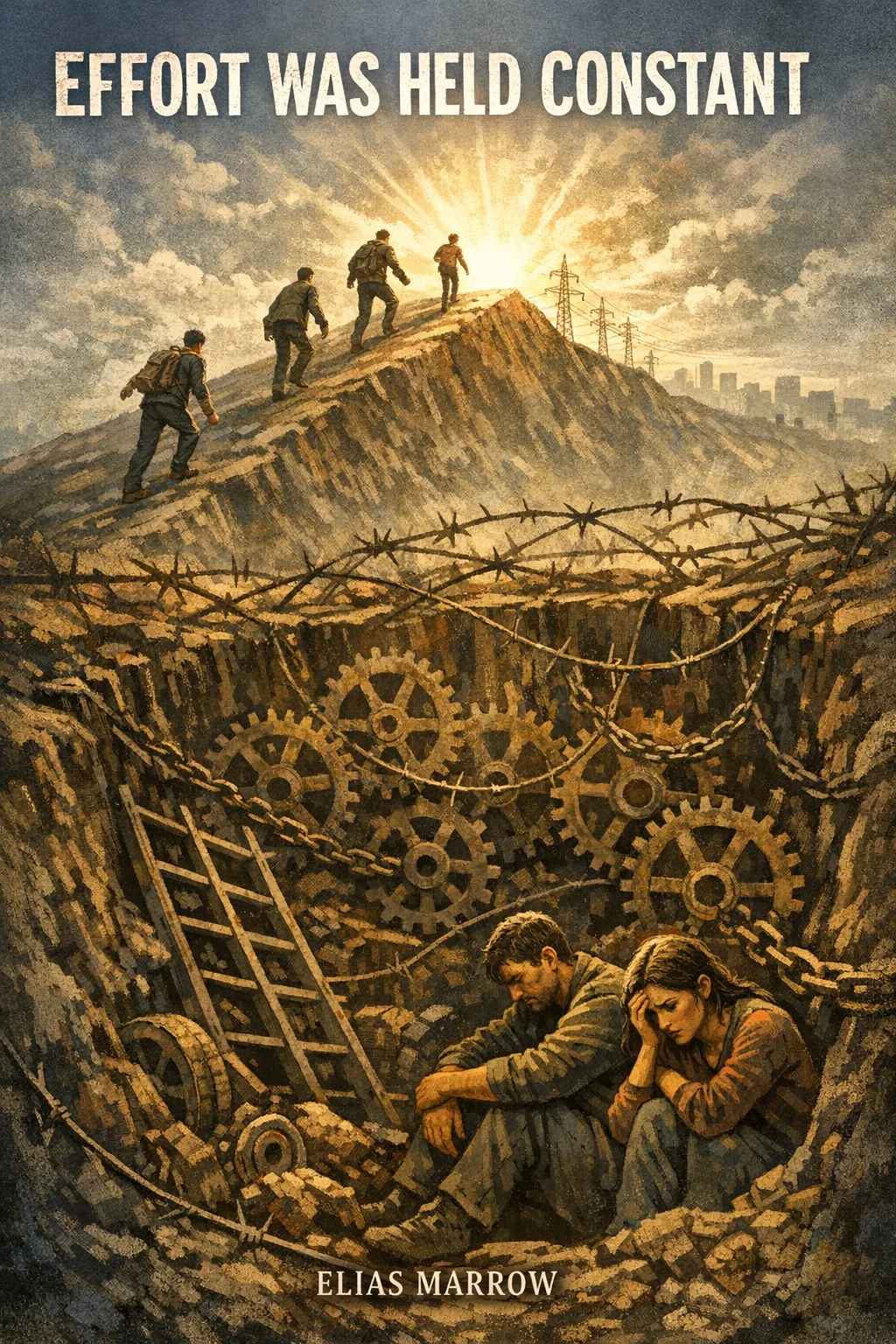
When effort is held constant and outcomes still fracture, choice loses its explanatory power.
Some people survive because nothing breaks at the wrong moment. Others fail because something does.
That is not morality. That is structure.
And pretending otherwise does not make the system fair—it only makes its victims easier to ignore
.