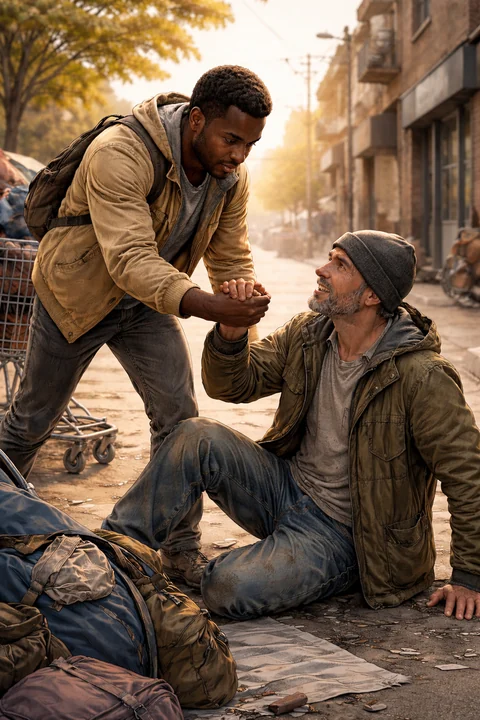
There is a strange accusation buried in modern life.
It appears whenever suffering becomes visible but unchanged.
Why do people accept this?
Why don’t they leave?
Why do they keep choosing it?
The implication is clear: if the pain continues, it must be voluntary.
But that framing misunderstands both humans and choice.
We are often told—implicitly or explicitly—that suffering is simply the cost of adulthood. Rent. Work. Exhaustion. Anxiety. The dull background hum of instability. These are presented not as failures of design, but as facts of existence.
Life is hard.
That’s just how it is.
And over time, that sentence does something subtle. It does not convince people that suffering is good. It convinces them that suffering is normal.
Normal is powerful. Normal does not provoke revolt. Normal only demands endurance.
From a biological standpoint, this makes sense.
Humans did not evolve to optimize happiness, fulfillment, or meaning. We evolved to survive. To preserve continuity. To avoid uncertainty that could threaten tomorrow.
Pain is not a warning sign in that framework. Pain is a negotiable cost.
If enduring suffering keeps food predictable, shelter intact, and social consequences contained, the nervous system accepts it as preferable to the unknown.
This is why people stay in jobs they hate.
Why they tolerate systems that erode them.
Why exhaustion becomes a badge of responsibility.
Not because they want to suffer—but because the alternative feels undefined, risky, or catastrophic.
This is where rhetoric enters—not to deceive, but to stabilize.
The system does not need people to believe suffering is noble. It only needs them to believe suffering is inevitable, individual, and morally meaningful.
If pain is framed as:
personal failure,
lack of effort,
a test of character,
then the structure causing it disappears.
Responsibility collapses inward. Shame replaces analysis.
People stop asking why this exists and start asking what is wrong with me.
That is not persuasion. That is containment.
At this point, someone will object:
“But people are choosing this. No one is forcing them.”
And this is where the conundrum tightens.
Agency does exist. But it exists inside narrow rails.
People choose:
which job, not whether wage labor determines survival,
which stress, not whether stability is conditional,
how close to collapse they live, not whether collapse is punished.
Choice is present. Freedom is constrained.
This creates the illusion of consent while preserving the outcome.
And because agency is technically involved, suffering is interpreted as deserved.
The most damaging effect of this arrangement is not pain itself.
It is what pain does to imagination.
When survival dominates cognition, the future contracts. People stop asking what a humane life would look like and begin optimizing only for continuity.
Next month replaces next decade.
Endurance replaces vision.
Stability replaces possibility.
And endurance is misread as agreement.
This is why it feels like we are choosing this.
We are choosing within the only options that feel real.
The unknown is not neutral—it is framed as reckless, immoral, or irresponsible. To step outside the system is not presented as exploration, but as failure.
So people stay. They adapt. They endure.
And then they are told their endurance proves the system is acceptable.
The truth is simpler—and more unsettling.
Most people are not willing to suffer.
They are conditioned to tolerate it, trained to fear disruption, and denied credible alternatives.
Calling that a choice is technically accurate.
Calling it free is not.
And the moment someone recognizes that distinction, the ground shifts.
Not because they suddenly know how to escape—but because they can no longer confuse endurance with consent.
That recognition alone does not dismantle the system.
But it removes its most effective disguise.
Suffering persists not because humans love pain—but because survival teaches us to accept almost anything that does not immediately kill us.
And the most efficient systems are the ones that never need to force compliance—only to make suffering feel normal.