Elias Marrow
Oct 4, 2026
Gender roles. What are they?
Where do we look for the base of them?
And once we find it, where does that journey take us?
A gender role is an expectation a society attaches to a sex: who provides, who protects, who raises. Most arguments about them begin in the middle, with what people ought to do now. This one starts further back, before culture, before language, with the oldest problem every living thing has to solve. How do you get your young to adulthood?
Animals have no gender roles in the human sense. They have no expectations, no customs, no shame. But they do divide labor by sex, and the way they divide it is not random. If there is a base under our roles, that is where to dig.
Strip the question to its frame and this is what remains: roles form out of necessity. They are the shape a species takes under the weight of raising its next generation.
One precision matters here. Evolution does not work for the good of the species as a whole. It works through each parent, each lineage, getting its own young through. But the result looks the same from a distance. Whatever arrangement keeps offspring alive in a given environment is the arrangement that persists.
Biologists have a name for the rule underneath. Robert Trivers called it parental investment theory in 1972. Roles divide according to who bears the cost of producing and raising the young, and whether one parent can carry that cost alone.
That gives two levers. First, who can do the work. Second, how heavy the work is. Pull those levers in different directions and you get every arrangement nature has tried.
Start with the mammals, because we are one.
A female mammal carries the pregnancy and then makes the only food the newborn can eat. The male can do neither. That single fact sets the first lever hard in one direction: for the earliest and most fragile stretch of life, only one sex can do the job.
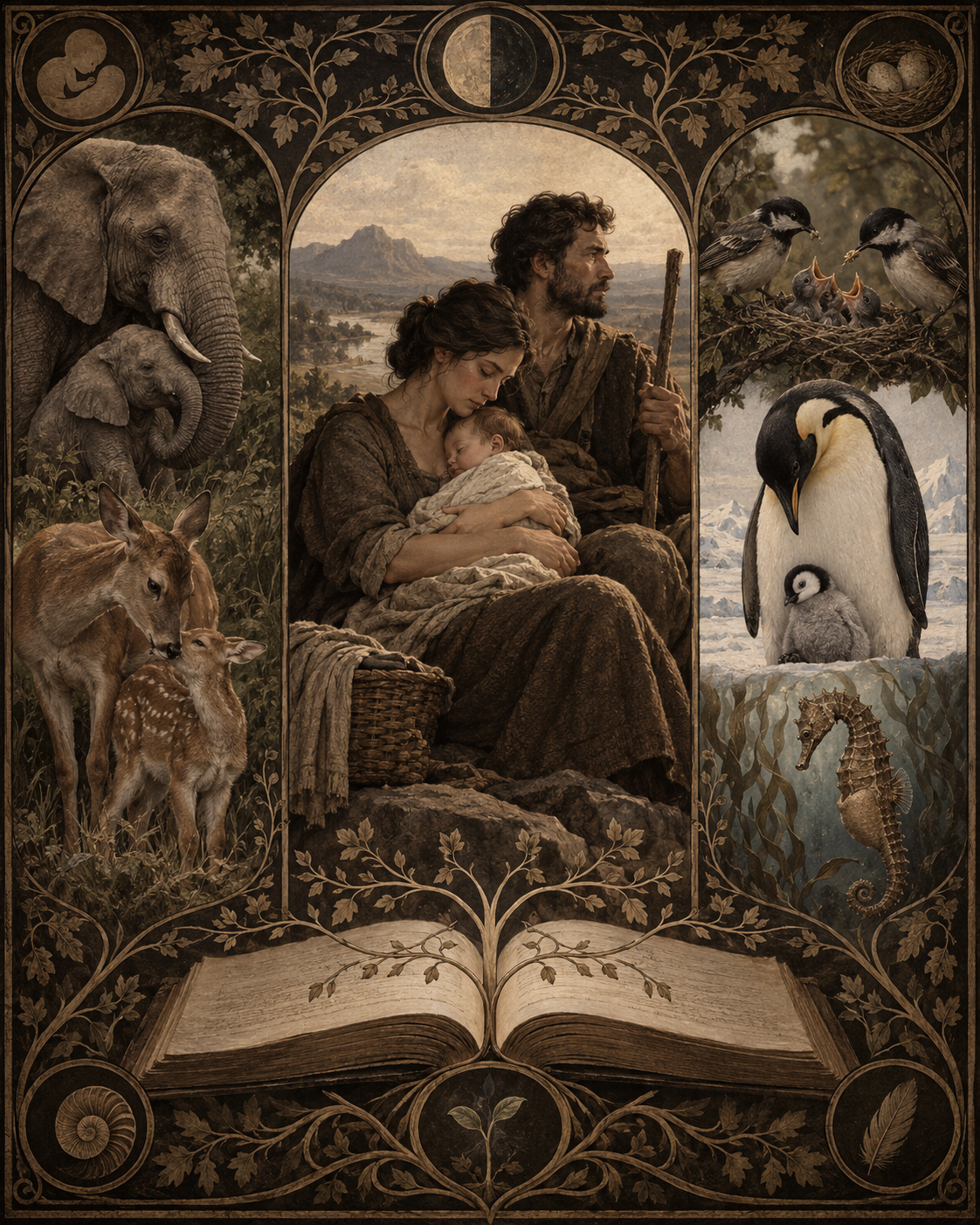
In species where a mother can manage the rest on her own, the arithmetic for the male changes. His help adds little. Another mate adds a great deal. So in most mammals, males move on. They compete for access to more females, and the females raise the young, alone or alongside their sisters. Elephants, deer, bears, most of the big cats: this is the common mammal pattern, not the exception.
The numbers bear it out. Only somewhere between five and ten percent of mammal species show meaningful care from fathers. In the rest, the father’s contribution ends at conception.
It is easy to read moral meaning into that. It has none. It is a species that can afford to let one parent go, and does.
Change the constraints and the roles change with them.
Sometimes the work is simply too heavy for one parent. Birds are the clearest case. A chick needs a steady stream of food that no single parent can keep up with, and either parent can catch an insect. So in roughly eight of every ten bird species, both parents raise the young. They trade shifts on the nest and at the hunt. Here the necessity pulls the sexes together instead of apart.
Sometimes it is the male who carries the young. Male seahorses and pipefish hold the pregnancy. Male emperor penguins balance the egg on their feet through the Antarctic winter while the females feed at sea. Among jacanas, the males incubate and rear, and the females are the larger, fiercer sex, defending territories that hold several mates. Flip who carries the cost and the competition flips with it.
And even among mammals, roles draw together when the young are expensive enough. The exceptions cluster exactly where the work becomes too much for a mother alone. Wolves, African wild dogs and dholes bring food back to pups with both parents and the pack. Marmosets and tamarins are cooperative breeders whose fathers and older siblings do much of the carrying. Even within the apes, the arrangements differ: chimpanzees run a male-dominated hierarchy, while their close cousins the bonobos are held together by female alliances.
The pattern holds across all of it. Where only one sex can do the work, roles split. Where the work is heavy and either sex can do it, roles converge.
We start where our nearest relatives start. We are primates and mammals. Our women carry the pregnancy and, for nearly all of history, made the only food an infant could survive on. The first lever is set the same way it is for a chimpanzee.
But the second lever is not. Human children are born more helpless and stay dependent longer than almost any animal’s. A toddler, a nursing infant, and the mother’s own need for calories are more than one forager could meet. The anthropologist Sarah Blaffer Hrdy argues this made us cooperative breeders, closer in this one way to marmosets than to chimps. Fathers, grandmothers, older siblings and neighbors carried the load together.
So humans landed in the rare mammal category: fathers who stay. Not as equals in every task, because the biology still split the earliest work. But closer to the shared end of the spectrum than most of our kin.
Then the constraints themselves began to move. Formula and pumps loosened the feeding bottleneck. Machines replaced muscle. Contraception gave choice over the timing of children. Economies shifted toward work either sex can do. For the first time, a species could change the conditions that had shaped its roles.
That is why the old roles have loosened so sharply in much of Europe, North America and parts of East Asia. Legal and formal barriers have largely fallen. Yet the loosening is not complete. In the International Labour Organization’s global time-use data, women did about three-quarters of all unpaid care work, roughly four hours and twenty-five minutes a day against about one hour and twenty-three minutes for men. Even in Norway and Sweden, women still do at least a fifth more unpaid work than men. Over two decades, men’s share grew by only minutes a day.
The roles have loosened. They have not disappeared. And that is where the real puzzle begins.
If roles were nothing but pressure from outside, removing the pressure should erase the differences. Some researchers argue the opposite has happened.
In 2018, Gijsbert Stoet and David Geary reported that countries scoring higher on gender equality, like Norway and Finland, had a smaller share of women among STEM graduates than less equal countries such as Algeria. Their reading: where economic necessity eases, people follow their own preferences more freely, and average preferences differ by sex. The economists Armin Falk and Johannes Hermle found a related pattern in survey data from 76 countries. Differences between men’s and women’s stated preferences grew larger, not smaller, in richer and more equal societies.
Read through the lens of this essay, the claim is striking. Lift the necessity that built the roles, and some difference remains anyway.
But it is one of the most fought-over findings in the field, and it has to be presented that way. Stoet and Geary’s paper required a lengthy correction after the Harvard researcher Sarah Richardson and colleagues could not reproduce its central measure. Critics argue the equality index it used is a poor stand-in for equality itself, and that other indices weaken or erase the link. A 2020 study by Thomas Breda and colleagues found that stereotypes tying math to men are actually stronger in wealthy, egalitarian countries, and could explain much of the pattern. Other work finds the correlations fade once cultural region is controlled for.
Defenders answer that independent studies like Falk and Hermle’s still point the same way.
What survives the fight is narrow but real: freer societies have not produced identical choices between the sexes. Whether that reflects deep preference, persistent culture, or both remains open.
So we come back to the three questions.
What are gender roles? At their base, they are solutions. Arrangements that formed because raising the young is costly, and the costs did not fall evenly.
Where do we look for that base? In the animals, not as mirrors but as a record. Every species shows its constraints in the way it divides the work. Where one parent can carry the load, the other leaves. Where the load is too heavy, both stay. Where the burden flips, the roles flip with it.
Where does that journey take us? To a place no other animal has stood. Humans began near our primate kin, bent toward shared care by our helpless children, and then did something new. We started changing the constraints themselves.
That cuts against both camps. To the traditionalist, it says the old roles were answers to old problems, and many of those problems are gone. To the progressive, it says that loosening the roles has not made every difference vanish, and the data on what remains deserves an honest look rather than a slogan.
Nature never handed us a script. It handed us a ledger of costs. For most of history the ledger decided for us. Now, for the first time, we get to read it and choose.
Sources and Confidence
Mammal paternal care at 5–10% of species; bird biparental care over 80–90%: San Diego Zoo Wildlife Alliance, Mètode, Quartz
Jacana and seahorse role reversal: Mètode
Nordic unpaid-work gap: COFACE Families Europe
Gender-equality paradox and its critiques: Richardson et al., BuzzFeed News on the correction, Wikipedia overview
From general knowledge, not re-verified here: Trivers (1972) on parental investment; Hrdy’s cooperative breeding thesis; Bateman reanalysis; Falk and Hermle’s 76-country sample; hyena, bonobo, marmoset and wild-dog examples. All are well established, but check before publishing.