by Elias Marrow
We did not begin as conquerors.
We began as soft things in tall grass.
No claws.
No armor.
No venom.
No speed that mattered.
But our greatest vulnerability was not physical.
It was infancy.
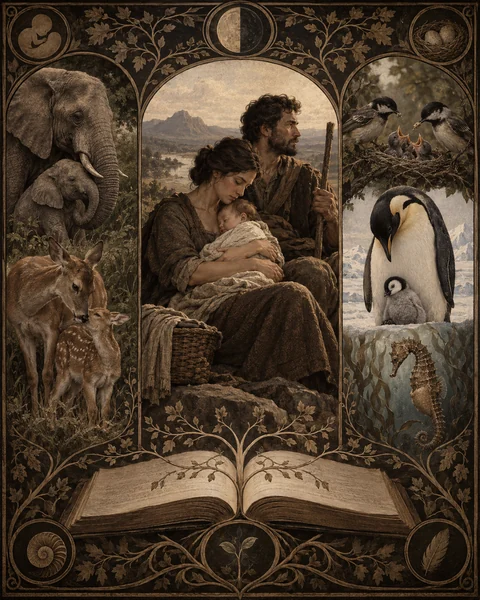
A human child is born unfinished.
Not weak in the way a fawn is weak.
Not ready in the way a wolf pup is ready.
Unfinished.
Where most animals arrive nearly formed, we arrive incomplete.
Helpless longer.
Dependent longer.
Malleable longer.
This was not an accident.
It was the hinge.
A long childhood meant the brain could wire itself to environment.
Not just to climate or predator patterns,
but to language,
to custom,
to story,
to rule.
Other species adapt through DNA.
We adapt through transmission.
A child does not inherit only genes.
A child inherits models.
How to speak.
How to trade.
Who to trust.
What is sacred.
What is property.
What is law.
Our infancy is extended so culture can finish us.
That was the second advantage.
The first was cooperation.
One human could be killed.
Three could surround.
Ten could remember.
Fifty could plan.
Coalition was survival.
But coalitions fracture.
They require memory.
They require trust.
They require consequence.
You cannot stabilize a group of fifty with instinct alone.
You must say:
There is danger beyond the ridge.
We move at dawn.
He did not share.
We do not trust him.
Language did not arise to write poetry.
It arose to stabilize the group.
Once words existed, something else emerged.
We could speak about things not present.
We could speak about tomorrow.
We could speak about rules.
We could speak about invisible forces.
And once we could speak about invisible forces,
we could coordinate around them.
A flag became a tribe.
A story became law.
A symbol became stored effort.
Abstraction compressed the world.
A coin held labor.
A mark held ownership.
A name held reputation.
But we did not stop at symbols.
We built symbols about symbols.
We built laws about laws.
Markets about markets.
Systems predicting systems.
Recursive abstraction.
A model of a model of a model.
Other animals adapt to weather.
We build shelter.
Other animals adapt to predators.
We build weapons.
Other animals compete within ecology.
We redesign ecology.
Agriculture did not make us evil.
It made us efficient.
Stored grain meant winter survival.
Stored grain meant property.
Property meant defense.
Defense meant hierarchy.
Hierarchy meant permanence.
Once energy could be stored, power could accumulate.
Once power accumulated, scale expanded.
Scale required administration.
Administration required records.
Records required symbols.
Symbols required trust.
Trust required narrative.
Narrative required belief.
And belief scaled faster than biology.
Culture replaced DNA as the primary driver.
We began optimizing not for the next meal,
but for the next generation,
the next dynasty,
the next quarter,
the next election cycle,
the next algorithmic pulse.
We became recursive.
We optimized the optimization process.
Markets optimized trade.
States optimized control.
Technology optimized production.
Algorithms optimized attention.
Every layer built on representation.
And each layer distanced us from the grass.
Other species plateau.
They find equilibrium.
We do not.
Because once you can model your own model,
you can redesign it.
Once you can redesign it,
you can accelerate it.
Once you can accelerate it,
you cannot easily stop.
We did not evolve to dominate.
We evolved to survive together.
Everything else is recursion.
But recursion does not ask whether it should continue.
It only asks whether it can.
When we stored grain, we stored winter.
When we stored winter, we stored fear.
When we stored fear, we stored power.
And power, once stored, does not dissolve politely.
It compounds.
A field becomes a boundary.
A boundary becomes a claim.
A claim becomes a defense.
A defense becomes a standing force.
A standing force becomes an institution.
An institution becomes permanence.
And permanence demands maintenance.
Maintenance demands structure.
Structure demands obedience.
None of it required a villain.
Only optimization.
The brain that once scanned grass for movement
now scans markets for fluctuation.
The instinct that once tracked reputation in a circle of fifty
now tracks status in a crowd of millions.
The fear that once kept us alive
now keeps us accelerating.
We optimize for energy.
We optimize for security.
We optimize for position.
And because we can represent position symbolically,
we can compete for it without end.
A deer does not accumulate ten winters of safety.
A wolf does not store territory across centuries.
A human can.
A human can store effort in code.
In contracts.
In debt.
In institutions that outlive the body.
And so our trajectory bends.
Not because we are smarter.
Not because we are evil.
But because we are unfinished.
Born incomplete.
Completed by culture.
Extended by memory.
Scaled by abstraction.
Other species adapt within ecosystems.
We redesign ecosystems.
Other species stabilize.
We scale.
And scale has no instinct for equilibrium.
It has instinct only for continuation.
This is why we feel the tension.
Our nervous systems are ancient.
They are calibrated for proximity.
For visible cause and effect.
For direct exchange.
But our structures are abstract.
You cannot see the full system.
You cannot hold it in your hand.
You cannot feel its boundaries.
Yet you feel its outcomes.
You feel scarcity.
You feel competition.
You feel displacement.
You feel acceleration.
The system is not thinking.
It is compounding.
Every individual optimizing locally.
Every institution optimizing structurally.
Every algorithm optimizing mathematically.
The sum becomes something that feels intentional.
But it is only layered survival logic.
We did not plateau because we replaced biological evolution with cultural recursion.
We did not stop because our tools began redesigning the conditions that created them.
We are the only species that can simulate collapse before it happens.
The only species that can choose constraint deliberately.
The only species that can ask:
What are we optimizing for?
That question is new.
Evolution did not require it.
But recursion makes it inevitable.
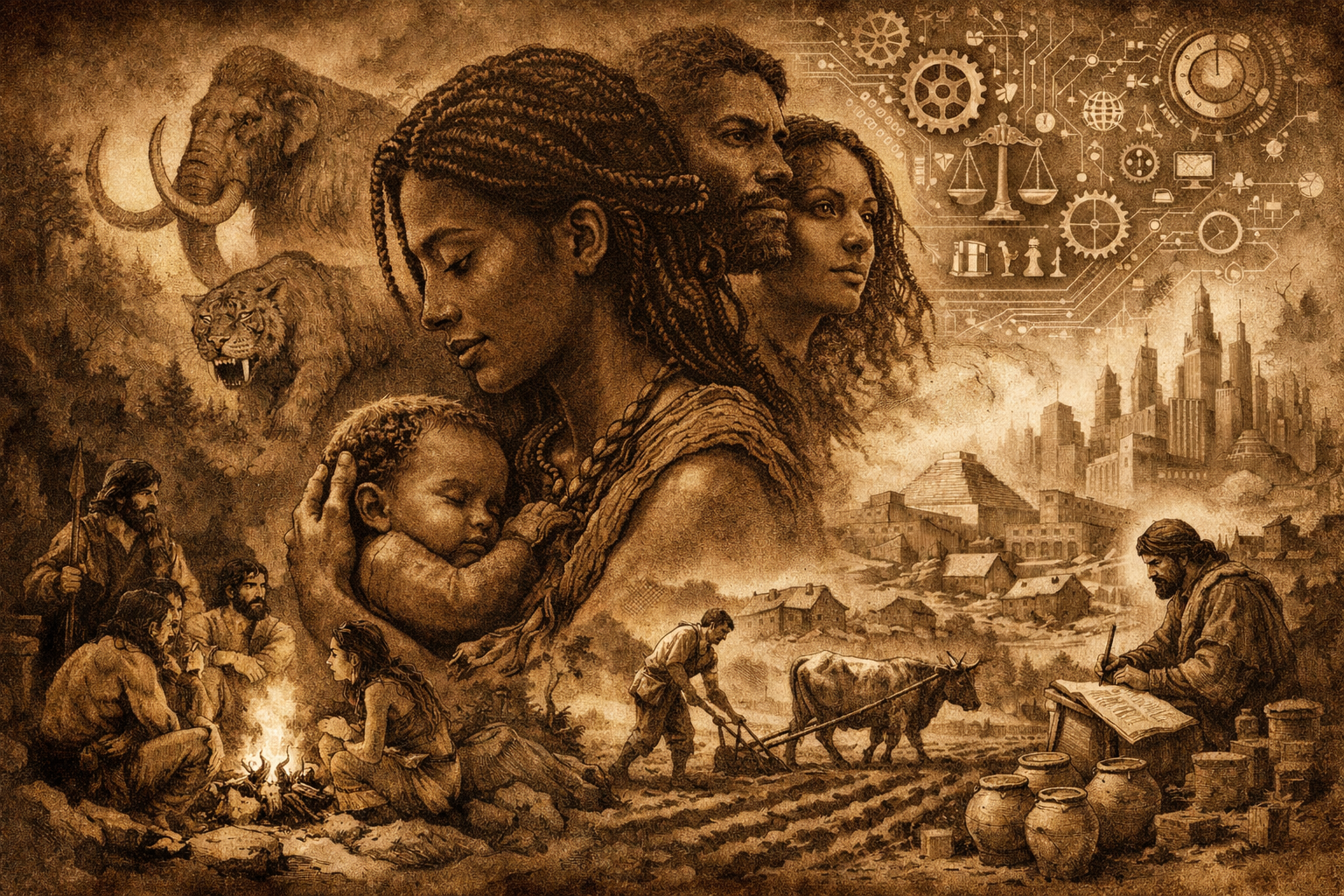
We began as soft things in tall grass.
We became unfinished children wired by culture.
We became symbolic animals.
Now we are system builders.
The difference between us and every other species is not strength.
It is that we never arrive complete.
And once you are never complete,
the next evolution
is chosen.