There are some decisions that do not arrive as decisions.
They arrive as progress.
They arrive with renderings, agreements, phrases like “regional investment” and “responsible infrastructure.” They arrive with the confidence of people who have already measured the land, priced the water, spoken to the agencies, and learned which words make a thing sound inevitable before the public has had time to understand what the thing is.
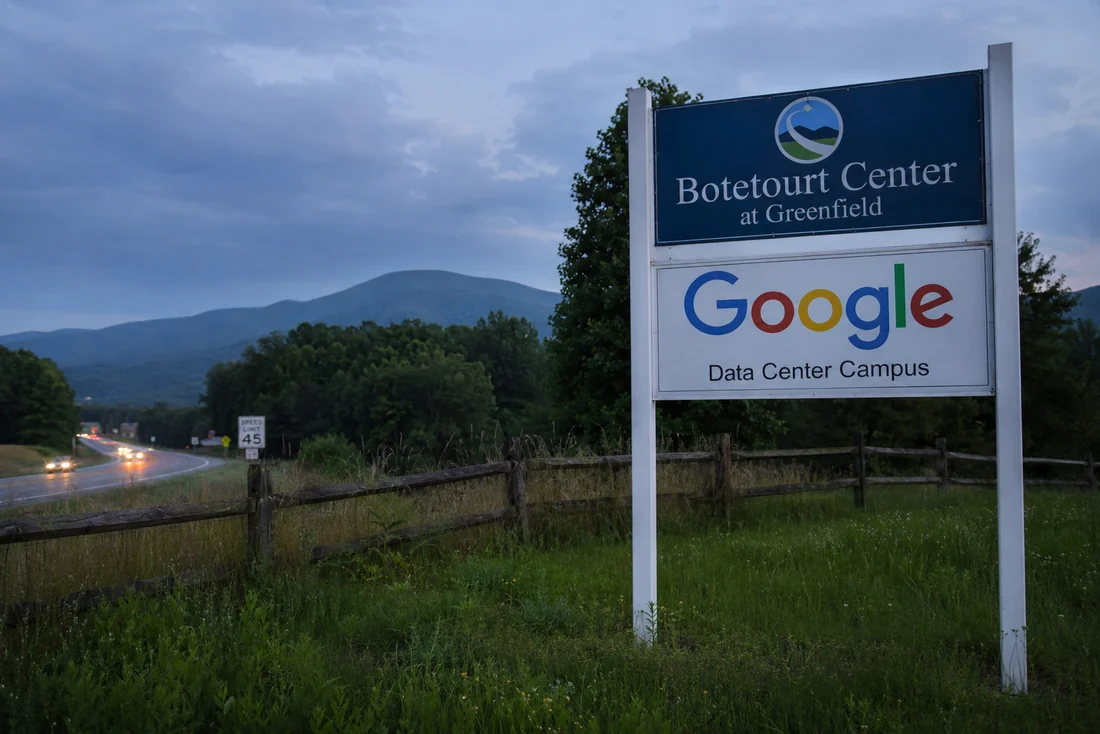
That is where the Roanoke Valley now finds itself with Google’s planned data center campus in Botetourt County.
On paper, it is simple enough. Google purchased 312 acres at Botetourt Center at Greenfield. The land is already industrial. The county says the site is out of public view, away from residential areas, near existing infrastructure, and within the only area of Botetourt zoned for a data center. Officials point to investment, tax revenue, community funding, and the kind of economic development announcement this region has spent decades trying to attract.
And that part is real.
A rural county does not casually ignore billions of dollars. A region that has watched factories close, wages stagnate, young people leave, and opportunity concentrate somewhere else does not dismiss a major employer because the word “Google” makes people uncomfortable. Botetourt is not wrong to want growth. Roanoke is not wrong to want relevance. Southwest Virginia is not wrong to wonder why prosperity always seems to pass over the mountains on its way to somewhere else.
But growth is not neutral just because it is expensive.
The question is not whether data centers exist. They do. Every email, bank login, streaming service, AI prompt, photo backup, medical portal, and small business website depends on buildings most people never see. The modern world has a physical body. It has pipes. It has substations. It has diesel generators. It has cooling systems. It has water intake and wastewater discharge and legal agreements and monthly bills paid by someone, somewhere.
The question is whether the people who live beside the infrastructure are allowed to understand the bargain before the bargain becomes permanent.
That is the part that keeps surfacing.
The Western Virginia Water Authority says the project can be served. It says Carvins Cove can initially supply the data center. It says Google will pay for the water it uses and for the infrastructure required to serve its operations. It says existing ratepayers will not be asked to fund those distribution upgrades. It says the system has capacity, the project will be metered, future increases will be reviewed, and private wells are not directly tied to surface withdrawals from Carvins Cove.
Those assurances matter.
But so does the fact that the water numbers became public only after pressure, legal challenge, and months of concern. So does the fact that the number now sitting in the public mind is not small: up to 2 million gallons per day at first, with the possibility of rising toward 8 million gallons per day if the campus expands. So does the fact that residents hear “not every day,” “seasonal,” “future review,” and “long-range planning,” while also watching the physical and legal shape of the project continue to advance.
Trust is not built by telling people the system can handle it.
Trust is built by showing people the system before they feel handled by it.
That is why the public reaction in Botetourt should not be dismissed as anti-technology or anti-business. It is something older and more local than that. It is the instinct people get when they realize a resource they thought of as common has been entered into an agreement they did not understand until after the language had hardened.
Water has a strange place in the Roanoke Valley.
It is not just utility service. It is memory. It is Carvins Cove after a dry spell. It is the Roanoke River after a storm. It is the creek behind someone’s house, the well on someone’s land, the lake level people quietly watch without needing a meeting agenda to tell them why it matters. People may not know every engineering detail, but they know enough to understand that water is not the same as a tax credit. You do not simply replace it with another line item.
Officials will say the reservoir is large. They will say planning has been done. They will say the data center does not decide the region’s entire water future. They may be right on those facts.
But residents are asking a different question.
They are asking what kind of region we become when our most valuable natural assets are evaluated through the needs of machines first and explained to people second.
This is the deeper issue beneath the Botetourt data center debate. It is not only water. It is legitimacy.
A project can be legal and still feel imposed. A vote can be public and still feel invisible if the public does not understand the consequence until after the terms are already moving. A county can receive money for fire trucks, dispatch upgrades, schools, libraries, and community projects, and residents can still wonder whether generosity becomes leverage when it arrives before consent feels complete.
That tension is not paranoia. It is the normal human response to scale.
Google is not a normal neighbor. It is not a machine shop, a warehouse, or a local manufacturer adding a shift. It is one of the largest technology companies in the world placing part of the physical backbone of artificial intelligence and cloud computing inside a valley whose identity is still tied to mountains, water, small towns, and the feeling that some things should remain understandable to the people who live here.
That does not mean the project must be stopped.
It means the burden of clarity belongs to the powerful.
If Google wants to be here, it should be expected to explain itself plainly and repeatedly. Not in polished language about stewardship. Not in the soft blur of corporate responsibility. In numbers. In maps. In drought scenarios. In noise modeling. In power demand. In emergency planning. In firm commitments about public reporting. In enforceable terms that still make sense twenty years from now, when today’s officials may be gone and the buildings remain.
If Botetourt wants to defend the project, it should not treat concern as obstruction. It should treat concern as the cost of governing something this large. People are allowed to ask whether fifty or one hundred fifty jobs justify a permanent industrial claim on water, land, energy, and local attention. They are allowed to ask who benefits first, who carries risk longest, and who gets to renegotiate if the future looks different than the presentation.
If the Water Authority wants trust, it should understand that technical capacity is not the same as public confidence. “We have enough water” answers one question. It does not answer whether the public believes the process respected them.
Roanoke and Botetourt are standing at the edge of a familiar American exchange: a powerful outside system offers money, infrastructure, and relevance, while the local community is asked to provide land, water, patience, and faith.
Maybe this becomes a responsible project.
Maybe the infrastructure is paid for. Maybe the water planning improves the region. Maybe the tax revenue helps Botetourt fund things it could not otherwise afford. Maybe the worst fears do not happen.
But the public should not have to rely on maybe.
Because once the grading starts, once the pipes are laid, once the buildings rise, the debate changes. The question will no longer be whether the valley should host the machine. The question will be how much of the valley the machine is allowed to require.
And by then, the most important decision may already have passed quietly through the room.
Not as a warning.
As an announcement.