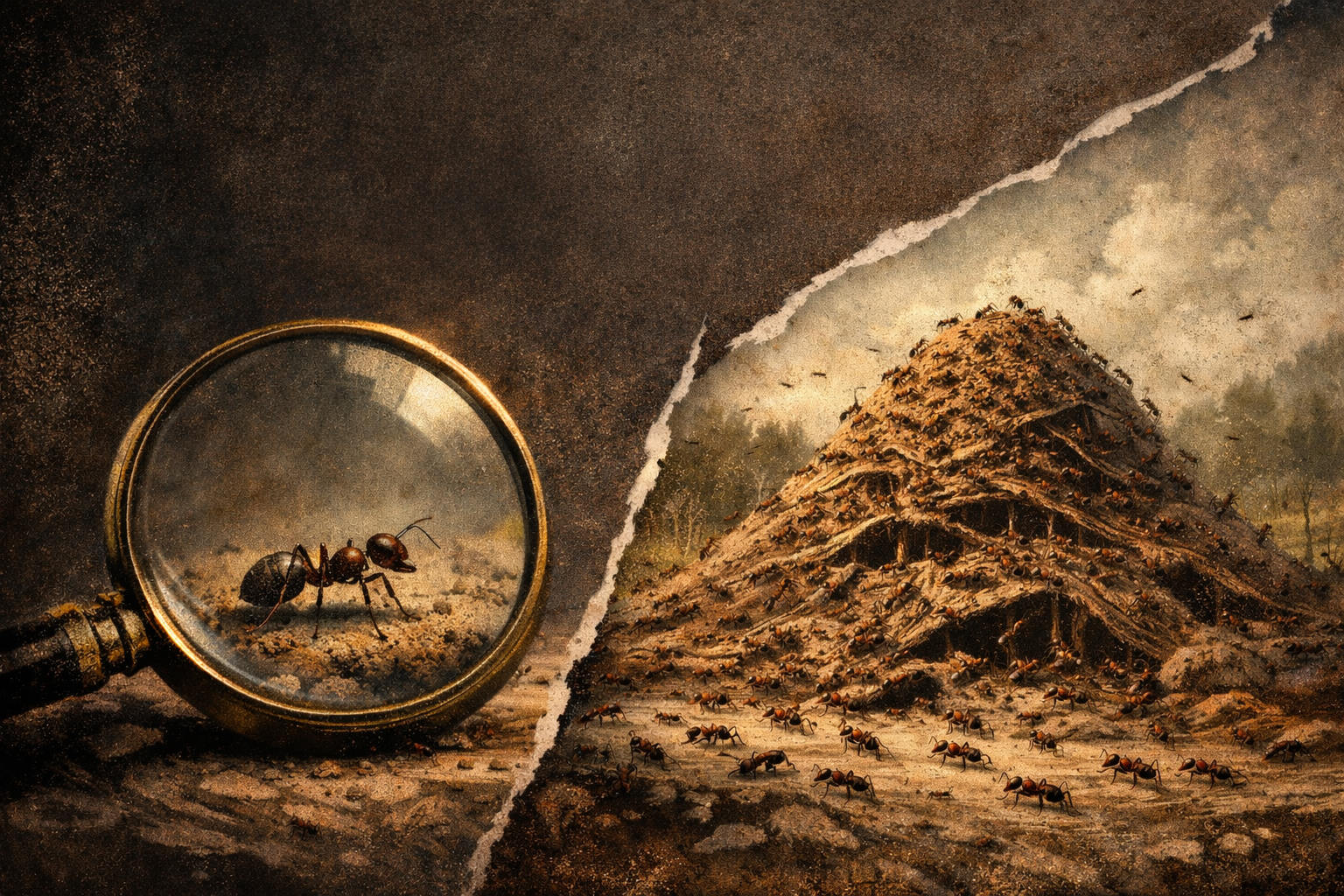
If you study an ant closely enough, you will learn many things.
How it moves.
How it reacts to obstacles.
How it searches.
How it responds to threat.
What you will not learn—no matter how long you watch—is what the ant hill will become.
An ant does not know it is building a city.
It does not understand architecture, or hierarchy, or waste management, or defense.
It follows simple rules.
Stay close.
Avoid danger.
Seek food.
Return home.
From those rules, a structure emerges that no ant designed and no ant could explain.
This is the mistake we keep making with ourselves.
We keep pointing to individual ants.
My friend worked hard and made it out.
I made better choices.
They just didn’t try hard enough.
We examine one life under a microscope and mistake it for an explanation of the whole.
But if you study only the ant, you cannot predict the ant hill.
Human decision-making works the same way.
Individually, our choices make sense.
They are adaptive.
They reduce risk.
They preserve energy.
They protect belonging.
Collectively, those same choices stack into something else entirely.
Short-term thinking becomes long-term collapse.
Risk avoidance becomes stagnation.
Attention-seeking becomes noise.
Comfort becomes compliance.
No one chooses the outcome.
Everyone chooses the step in front of them.
And the system listens.
Not to what we say.
Not to what we believe.
Not to what we claim to want.
It listens to what we do.
We like to imagine systems as distant things.
Abstract.
Manipulative.
Intentional.
But most systems are not intelligent in the way we mean it.
They do not persuade.
They do not argue.
They do not moralize.
They measure.
They measure clicks.
They measure views.
They measure purchases.
They measure compliance.
They measure hesitation.
They respond to signals that carry cost.
Words are cheap.
Actions are expensive.
Attention is currency.
So when people say, “This isn’t what we asked for,”
the system checks the ledger.
And the ledger says otherwise.
This is the part that makes people uncomfortable.
Because it doesn’t mean people are bad.
And it doesn’t mean people are free.
It means behavior under constraint is predictable.
When attention is exhausted, we choose what is loud.
When time is scarce, we choose what is easy.
When stress is constant, we choose what is familiar.
The system does not misread this.
It reads it perfectly.
It gives us more of what we reward with time and focus.
Less of what we ignore.
And almost nothing of what requires sustained effort without immediate payoff.
Not because it wants to.
Because that is what optimization does.
This does not mean anger is wrong.
Or that protest is meaningless.
Or that speaking out is naïve.
Anger is often accurate.
Voice is often necessary.
But systems do not respond to conviction alone.
They respond to cost.
Expression relieves pressure.
Leverage changes behavior.
Sometimes protest disrupts.
Sometimes it withdraws participation.
Sometimes it fractures consensus.
And when it does, it works.
When it doesn’t, it is absorbed—not dismissed, but metabolized—because nothing essential had to change.
This is not a judgment.
It is a description.
This is why outrage spreads faster than nuance.
Why spectacle outpaces substance.
Why repetition feels like consensus.
Why the shallow rises while the deep waits unseen.
Not because truth is suppressed.
But because truth is heavy, and attention is tired.
No conspiracy is required for this to work.
Only patterns.
Only ants following rules that once kept them alive.
Once you realize this, something shifts.
Not into blame.
Not into guilt.
But into clarity.
They are not giving us what we ask for with words.
They are giving us what we ask for with action and attention.
The system is not confused.
It is obedient.
And the ant hill is exactly what it was always going to be—
given how the ants learned to move.