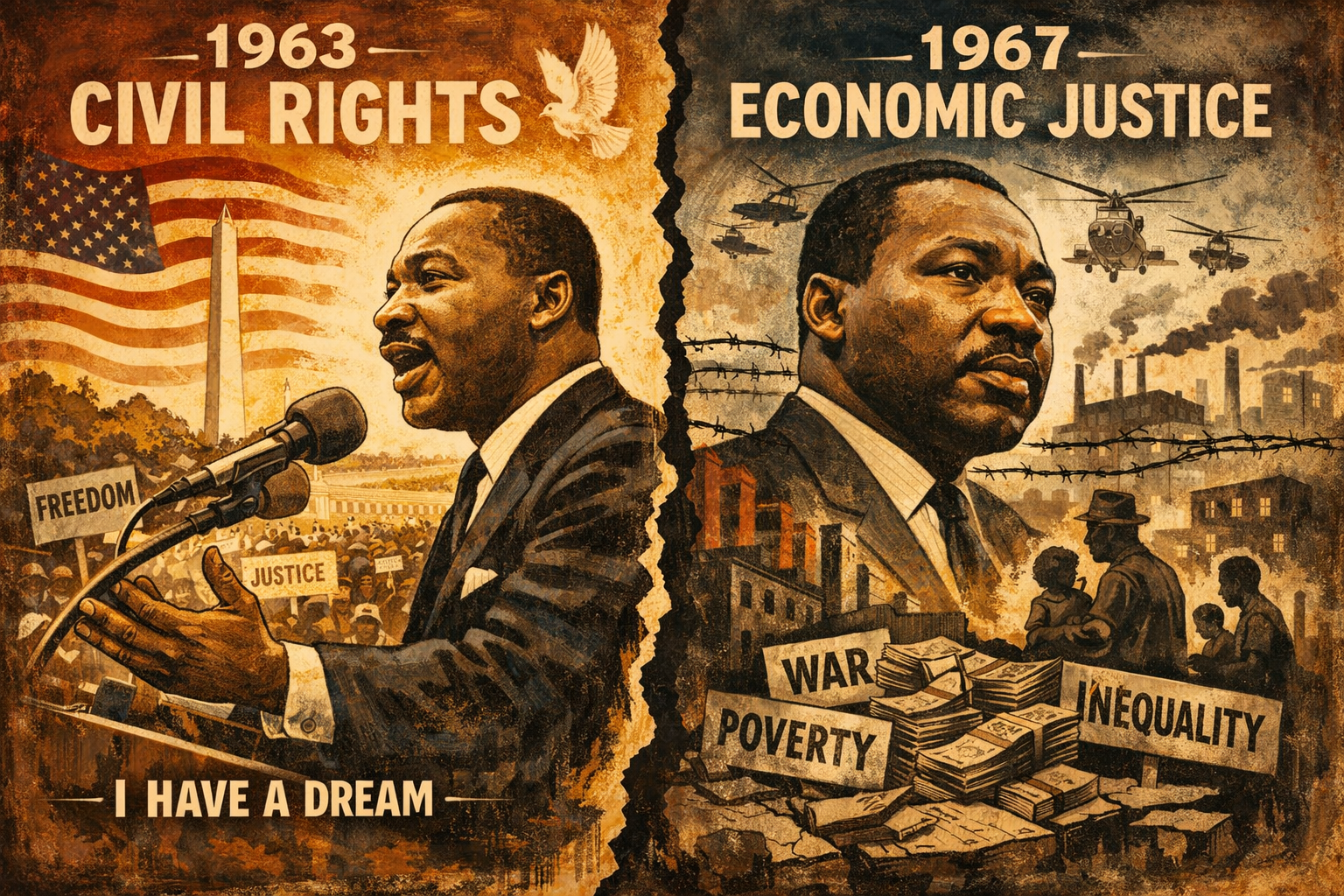
The Shift: From Integration to Transformation
Studying Martin Luther King Jr. is studying a man who won the argument he was hired to make—
and then refused to stop talking.
There is a version of King America prefers.
A version that fits inside a holiday.
A version that can be quoted without consequence.
A version that asks for kindness but not restructuring.
That version ends in 1963.
The real shift begins after the applause.
I. When Equality Hits the Wall
In the early years, the enemy was visible.
Segregation statutes.
Voter suppression.
Sheriffs with dogs.
The moral picture was clear.
Remove the law.
Remove the barrier.
Remove the sign that says Whites Only.
And when those victories came—the Civil Rights Act (1964), the Voting Rights Act (1965)—the nation declared progress.
But something unexpected surfaced.
Legal equality did not level the terrain.
You could remove the sign
and still guard the door.
You could grant the vote
and still restrict economic movement.
You could declare freedom
and still engineer containment.
This is where the shift begins.
II. Chicago: The Moment the Frame Breaks
In 1966, King moves north.
Not into the mythology of Southern brutality—
but into the quiet machinery of Northern inequality.
Housing contracts.
Redlining.
Urban zoning.
Property value protection.
The Chicago Freedom Movement exposes a different kind of segregation.
Not enforced by statute, but by system.
You cannot march against a mortgage rate.
You cannot dramatize a zoning board.
You cannot televise the violence of a map.
And that is precisely the point.
King is no longer confronting overt discrimination.
He is confronting structure.
III. From Reform to Structural Critique
By 1967, King’s language hardens.
In Where Do We Go From Here: Chaos or Community?, he moves beyond desegregation and toward economic redesign.
He begins speaking of guaranteed income.
Full employment.
Economic rights.
He is no longer asking for access to the American promise.
He is questioning how the promise distributes reward in the first place.
This is the difference:
Reform corrects policy.
Transformation questions incentive.
Reform removes legal barriers.
Transformation interrogates outcome patterns.
And once you question outcomes, you step into dangerous territory.
Because outcomes reveal who benefits.
IV. The “Triple Evils”
April 4, 1967. Riverside Church.
King names what he calls the “giant triplets”:
Racism.
Extreme materialism.
Militarism.
This is the moment he links domestic poverty to foreign war.
Links labor exploitation to military spending.
Links racial injustice to economic extraction.
Now the problem is not a region.
It is a national operating system.
And that shift is not symbolic.
It is destabilizing.
Because once racism is understood as a tool within a larger economic and military structure—
the conversation moves from morality
to architecture.
And architecture implicates power.
V. The Poor People’s Campaign
By late 1967, King organizes the Poor People’s Campaign.
Multiracial.
Economic.
Direct.
Not “let us in.”
But “restructure what produces poverty.”
This is no longer civil rights in the narrow sense.
It is human rights.
Material rights.
The right to exist with dignity inside an economy.
And here is the realization sitting beneath all of it:
Rights without resources are symbolic.
Access without leverage is containment.
Legal equality without economic mobility preserves hierarchy—quietly.
VI. Why This Made Him Dangerous
America could tolerate King the reformer.
America could celebrate King the dreamer.
America struggled with King the structural critic.
Because once he moves from integration to transformation—
he is no longer asking to sit at the table.
He is asking who built the table.
Who profits from the seating arrangement.
Who funds the room.
And why some are always closer to the exit.
That is not a civil request.
That is systemic interrogation.
And systemic interrogation threatens stability.
VII. The Uncomfortable Truth
Equal rights did not change the playing field.
They changed the rules on paper.
The physics remained.
The incentive structures remained.
The economic hierarchies remained.
King saw that.
And once he saw it, he did not retreat.
That is the shift.
Not a change in tone.
A change in target.
From visible injustice
to invisible architecture.
From integration
to transformation.
And history remembers the first more comfortably than the second.
Because the first can be celebrated.
The second would require change.