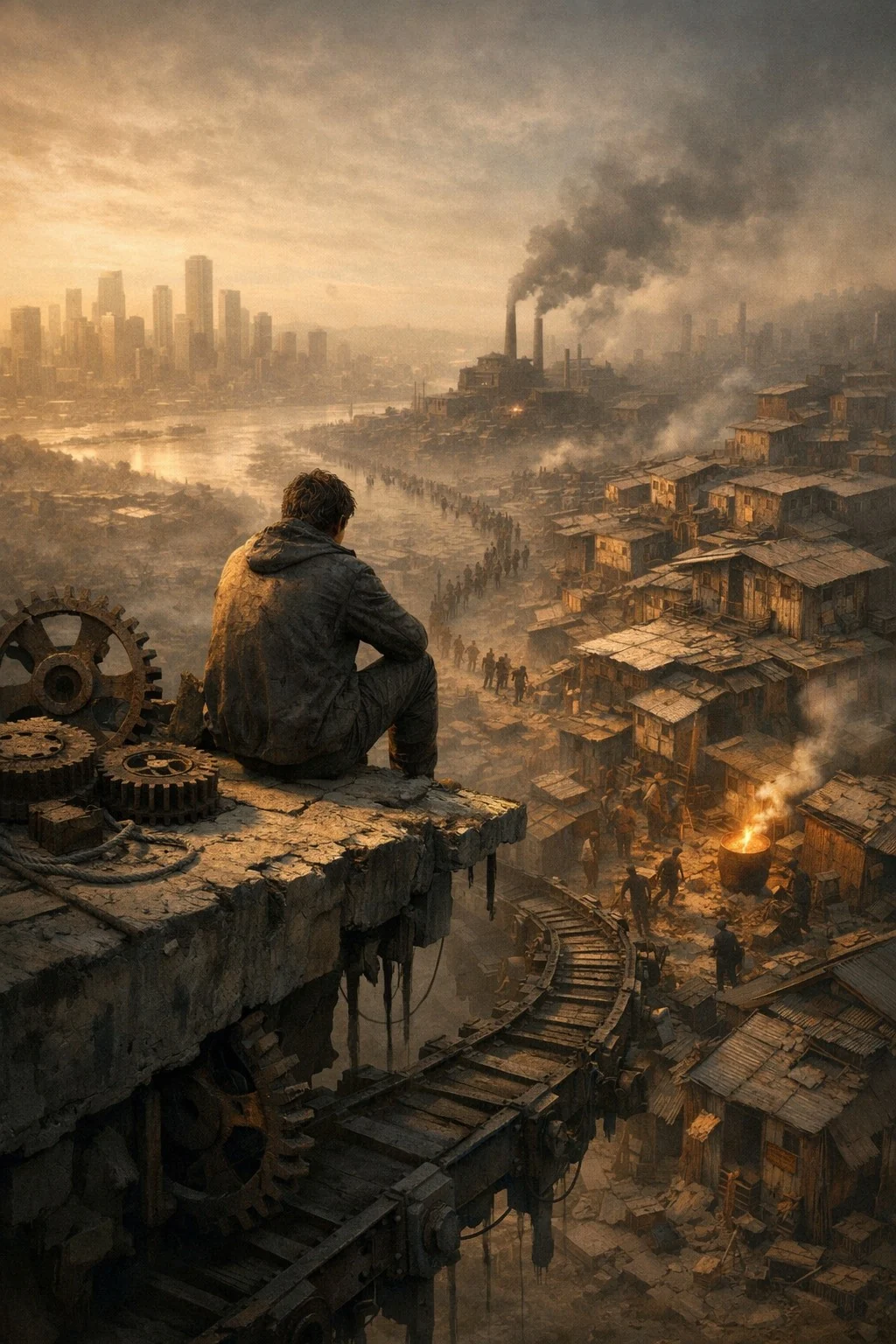
Modern societies tell a comforting story about poverty. It is framed as a failure of effort, judgment, or discipline — an unfortunate outcome, but not a necessary one. The implication is simple: if people worked harder, planned better, or made fewer mistakes, poverty would recede on its own.
This story persists because it feels moral. It assigns responsibility. It preserves the belief that the system itself is neutral, even benevolent. But stories can be tested. And when they are, a different pattern begins to emerge.
The question is not whether poverty harms people. That is obvious. The harder question is whether persistent poverty plays a stabilizing role within the systems that produce it. If it does, then poverty is not merely a failure state — it is a functional one.
To understand this, we have to stop thinking in terms of intention and start thinking in terms of structure. Large systems do not need malice to generate harm. They only need constraints that must be continuously met in order to survive.
A constraint-based system is one where survival depends on clearing non-negotiable thresholds: housing must be paid for, income must continue, health must be maintained, credit must remain intact. Miss one long enough, and consequences compound rather than reset. Stability is not restored by effort alone, but by having room when something goes wrong.
In such systems, some level of failure is not accidental. It is expected. If no one ever fell behind, the narrative of merit would collapse. If everyone fell behind, legitimacy would collapse. Stability exists in the narrow space between those two outcomes.
This is why poverty can become functionally useful. It disciplines labor by making the cost of refusal visible. It contains costs by concentrating volatility at the margins. It reinforces moral narratives by offering examples of both success and failure. And it absorbs shocks that might otherwise destabilize the whole system.
None of this requires conscious design. No committee needs to decide that people should remain poor. Systems select for arrangements that survive, and arrangements that eliminate all pressure tend not to survive for long. Scarcity, when managed, becomes a stabilizing force.
But there is a limit. Poverty stabilizes systems only up to the point where it can still be rationalized. When people no longer believe effort leads anywhere, when recovery feels impossible rather than delayed, poverty stops disciplining and starts delegitimizing.
History is clear on this. Periods of unrest, withdrawal, and rupture follow moments when constraint overwhelms belief. Systems respond not by eliminating scarcity, but by managing it — through relief, reform, rhetoric, and opposition. Pressure valves open just enough to prevent collapse.
This is where opposition becomes essential. Modern democracies rely on visible conflict not only for accountability, but for legitimacy. When harm is inevitable, it must be argued over. One side explains suffering as necessary or deserved. The other explains it as unfortunate and deserving of relief. The conflict is real. The structure remains.
Opposition is not theater in the sense of falsehood. It is theater in the sense of function. Moral disagreement distributes responsibility and preserves belief without requiring structural transformation. The system continues, intact.
This does not mean reform is meaningless. Relief matters. Suffering reduced is suffering prevented. But reforms that do not alter the constraints themselves will change outcomes at the margins, not at the root.
The uncomfortable conclusion is not that poverty is wanted, but that it is tolerated — managed within a range that preserves continuity. Systems do not optimize for human flourishing. They optimize for survival.
Understanding this does not demand cynicism. It demands clarity. Effort still matters. Compassion still matters. But neither effort nor compassion explains why failure persists in predictable patterns across time.
Poverty, in this light, is not a moral verdict. It is a signal. A measure of how a system balances pressure against legitimacy. When that balance breaks, history moves.
The question, then, is not whether poverty is bad. It is whether we are willing to confront the constraints that make it functional — and what happens when those constraints are finally no longer tolerated.