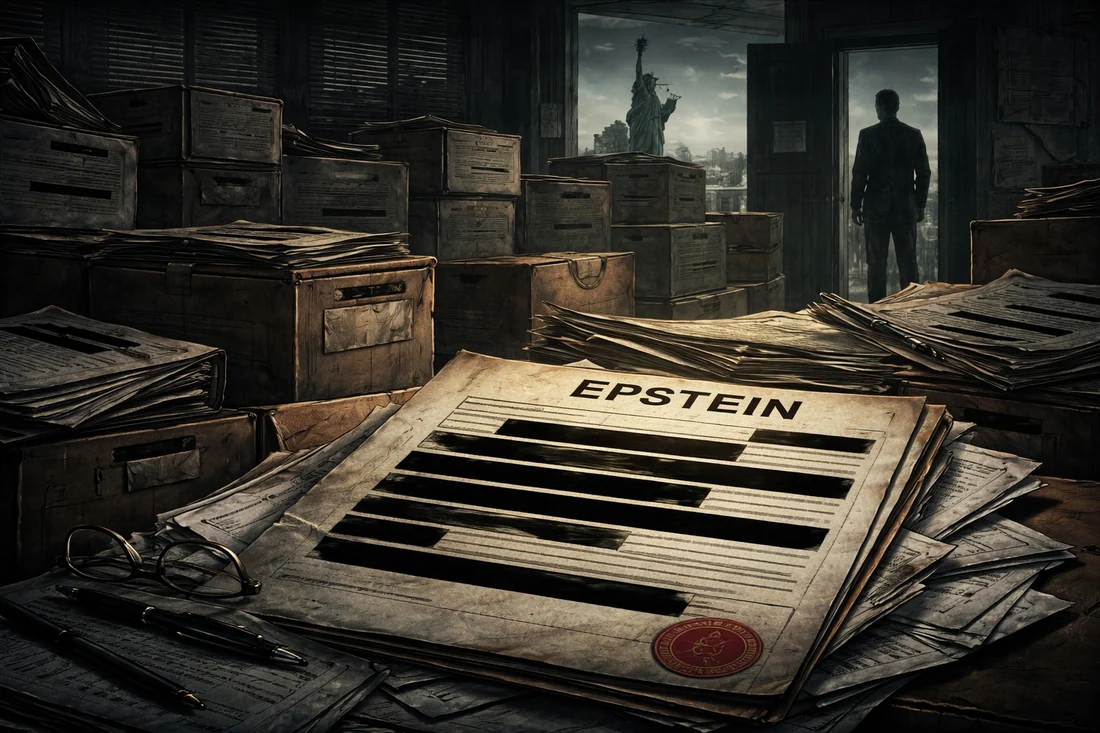
When the Epstein files are discussed, the conversation almost immediately collapses into a single question: Who is being protected? The assumption is intuitive. If names are redacted, someone must be guilty. If the redactions persist, someone powerful must be hiding something. And if the most visible name adjacent to the scandal is Donald Trump, then the moral gravity of the scandal is conveniently assigned to him.
This conclusion feels obvious. It is also, statistically, the least precise explanation available.
To understand the Epstein redactions honestly, one must abandon moral storytelling and analyze how institutions behave under existential exposure. The truth is not flattering, but it is consistent.
Redaction as a Systemic Decision, Not a Moral One
Redaction is not a confession. It is a risk-management tool.
The Epstein case is not dangerous because of what one individual did. It is dangerous because it reveals how long Jeffrey Epstein operated despite being known, flagged, investigated, and quietly deprioritized. It exposes not a failure of detection, but a failure of will. That distinction matters.
Institutions redact information when disclosure threatens legal precedent, civil liability, intelligence methods, prosecutorial legitimacy, and public trust in enforcement systems.
In other words, redaction occurs when the cost of transparency exceeds the cost of suspicion. From an institutional standpoint, public distrust is survivable. Structural accountability is not.
Why Blanket Redaction Persists Even Without Specific Evidence
A common argument goes as follows: if a named individual is innocent, why not release everything and clear their name? This question assumes institutions exist to resolve truth claims. They do not. They exist to preserve continuity.
The Epstein materials intersect with multiple administrations, federal prosecutors, plea agreements, non-prosecution decisions, financial regulators, intelligence-adjacent actors, and high-net-worth private citizens across decades.
Once a file implicates systemic negligence, selective transparency becomes impossible. You cannot reveal partial truth without triggering full exposure. As a result, the rational institutional choice is to redact broadly, even when individual guilt varies widely.
This means that innocence does not guarantee visibility. It guarantees nothing.
Why Specific Figures Become Default Villains
The persistence of targeted suspicion in cases like this is not always evidence-based. It is psychologically efficient.
Epstein represents systemic corruption too large to emotionally process. Assigning blame to a single visible figure reduces cognitive overload. That figure already occupies an antagonist role in many political identities. The scandal becomes a reinforcing chapter, regardless of evidentiary necessity.
This is not conspiracy. It is human pattern recognition under stress.
What the Evidence Actually Supports
Social proximity in elite networks does not imply operational cooperation. No verified evidence establishes joint criminal enterprise with most figures named in speculation. Institutional redaction is driven by system exposure, not individual protection. Continued redaction is consistent with risk avoidance, not proof of guilt.
The Hard Truth Most People Avoid
The most unsettling conclusion is not that any particular individual might be hiding something.
It is that Epstein was not an anomaly.
He functioned as a stress test for elite accountability and the system failed. Prosecutors deferred. Institutions stalled. Social circles rationalized. And when the damage became undeniable, the response was not truth, but containment.
Redaction is the final stage of that containment.
Why "If You Have Nothing to Hide" Is a Civilian Illusion
That phrase applies to individuals, not power structures.
For institutions, truth creates liability. Liability creates instability. Instability threatens continuity. In such systems, ambiguity is safer than clarity, and silence is safer than justice.
Conclusion
The Epstein redactions do not prove any individual's guilt. They do not prove innocence either.
They prove something far more damning: the system cannot survive full honesty about how Epstein operated, who tolerated him, and why no one stopped him sooner.
Individuals become villainized not because evidence demands it, but because systems require a face to absorb outrage. It is easier to argue about one man than to confront decades of structural complicity.
This is not the truth we are given. It is the truth we arrive at when we stop asking who the villain is, and start asking why the system cannot tell the truth about itself.