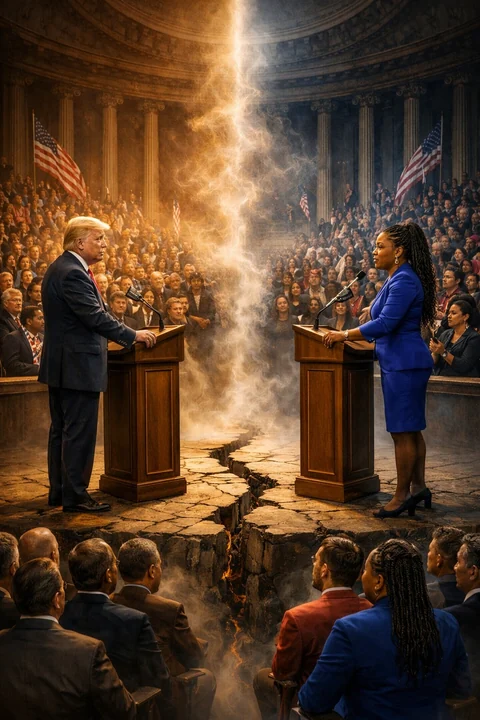
Joe Biden did not ascend to the presidency because the American public believed he would meaningfully restructure power, incentives, or material outcomes. He was chosen because he represented the absence of disruption. Where Donald Trump functioned as a destabilizing force within the political system, Biden was selected to stabilize it.
This distinction is critical. Biden's presidency was not a rejection of the system that produced Trump, but a corrective response designed to absorb the shock Trump represented. Biden did not run as a visionary. He ran as a custodian. His campaign message was not transformation, but restoration — not of economic conditions, but of tone, norms, and procedural legitimacy.
In systems under stress, leadership selection often prioritizes containment over reform. Biden's political value lay in his familiarity, his predictability, and his deep institutional integration. He was legible to elites, bureaucracies, and international partners precisely because he was shaped by the same system now attempting to preserve itself.
II. Biden as an Institutional Actor, Not an Outsider
Unlike Trump, who entered the presidency as an external disruptor, Biden is a product of the system in its most orthodox form. His power does not come from confrontation with institutions, but from fluency within them. Decades in the Senate and executive branch trained him not to challenge institutional boundaries, but to operate inside them efficiently.
This matters because institutions are not neutral containers. They encode incentives, protect certain forms of power, and constrain others. A leader deeply embedded within these structures is far more likely to preserve their internal logic than to dismantle or reconfigure it.
Biden's governance reflects this reality. His approach emphasizes coalition maintenance, incremental adjustment, and procedural continuity. These are not failures of leadership; they are expressions of a managerial mode of power that values stability over risk. But managerial power, by definition, cannot resolve structural misalignment. It can only manage its symptoms.
III. Stability as a Political Deliverable
Under Biden, stability itself became the primary metric of success. Calm replaced chaos. Predictable rhetoric replaced spectacle. Institutional decorum replaced confrontation. These changes were real — and for many, deeply relieving.
But stability is not synonymous with progress.
When stability becomes the end goal, material outcomes become secondary. Housing affordability, healthcare access, wage stagnation, and debt burdens remain structurally unresolved, yet the absence of visible crisis allows these failures to recede from political urgency.
This reframing alters public expectations. Governance is no longer evaluated on whether life improves, but on whether life feels less volatile. In this environment, the system can continue producing unequal outcomes while being perceived as functional.
Biden's presidency did not reverse decline. It made decline quieter.
IV. Incentives That Prevent Structural Change
The absence of deep reform under Biden is often attributed to political opposition or legislative gridlock. This explanation is incomplete. The more accurate account lies in aligned incentives across power centers.
Political parties depend on donor confidence. Donors benefit from predictable markets. Bureaucracies resist disruption. Media institutions thrive on stability punctuated by manageable controversy. Structural reform threatens all of these interests simultaneously.
Biden's presidency aligns with these incentives. Even when progressive rhetoric appears, implementation remains bounded by what existing power structures can tolerate without destabilizing themselves. Reform becomes symbolic rather than transformative. Policy adjusts at the margins while core incentive systems remain intact.
This is not deception. It is structural coherence.
V. Normalcy as a Substitute for Legitimacy
A central function of the Biden presidency has been the restoration of institutional legitimacy through normalcy. By adhering to established norms, Biden re-legitimizes institutions that were openly questioned during the Trump era.
But legitimacy restored through appearance rather than outcome is fragile.
Institutions gain trust not merely by behaving correctly, but by delivering results that align with public needs. When legitimacy is maintained through process rather than performance, disillusionment accumulates beneath the surface.
Biden's governance style reassures those invested in institutional continuity while leaving underlying material conditions largely untouched. The result is a widening gap between institutional confidence and public confidence.
VI. Why Decline Feels Like Improvement
One of the most powerful psychological effects of Biden's presidency is contrast. Following an era of constant disruption, the slowing of deterioration is perceived as recovery. Expectations recalibrate downward. What once would have been unacceptable becomes tolerable by comparison.
This effect does not require propaganda. It emerges naturally from exhaustion.
When people are fatigued, they confuse relief with progress. Biden benefits from this dynamic. Modest policy adjustments and symbolic wins are amplified because the baseline against which they are measured is unusually low.
But contrast cannot change trajectories. It only alters perception.
VII. Fear Without Mobilization
Unlike Trump, who mobilized fear through spectacle and antagonism, Biden governs in an environment of diffuse, abstract anxiety. Threats are framed in institutional terms — democratic norms, procedural erosion, global instability — rather than immediate material danger.
Abstract fear does not mobilize sustained action. Without a clear antagonist, urgency dissipates. Governance defaults to maintenance. Systems drift toward inertia.
This absence of mobilization reinforces managerial governance. Without pressure, institutions revert to their equilibrium state: self-preservation.
VIII. Biden and Trump as Complementary System Functions
Trump and Biden are often treated as opposites. Structurally, they are complements.
Trump exposed institutional fragility through disruption. Biden absorbs that disruption through stabilization. One stresses the system; the other repairs its surface without altering its foundations.
Together, they reveal a system capable of surviving shocks but resistant to evolution. Crisis alternates with containment. Neither mode produces structural realignment.
The problem is not the individuals. It is the system that selects for these roles.
IX. The Cost of Managed Decline
The danger of Biden's presidency is not authoritarianism or collapse. It is stagnation.
When decline is managed rather than confronted, legitimacy erodes slowly. Participation feels performative. Electoral change alters tone but not trajectory. Trust decays not through betrayal, but through attrition.
Managed decline preserves institutions while hollowing belief in their purpose.
X. What This Reveals About Power
Biden's presidency demonstrates that power does not always operate through domination or spectacle. It can operate through calm, restraint, and procedural correctness. This form of power is harder to oppose because it does not provoke — it anesthetizes.
The system does not need villains to persist. It needs managers.
And as long as stability is valued more than alignment, decline can continue indefinitely — quietly, competently, and with broad institutional approval.